
The Minimum Viable Authority: Why Your Next Business Needs a Framework, Not a Vision
Stop selling your time and start selling your system. Learn how to turn your expertise into a "Black Box" framework that builds real business authority.

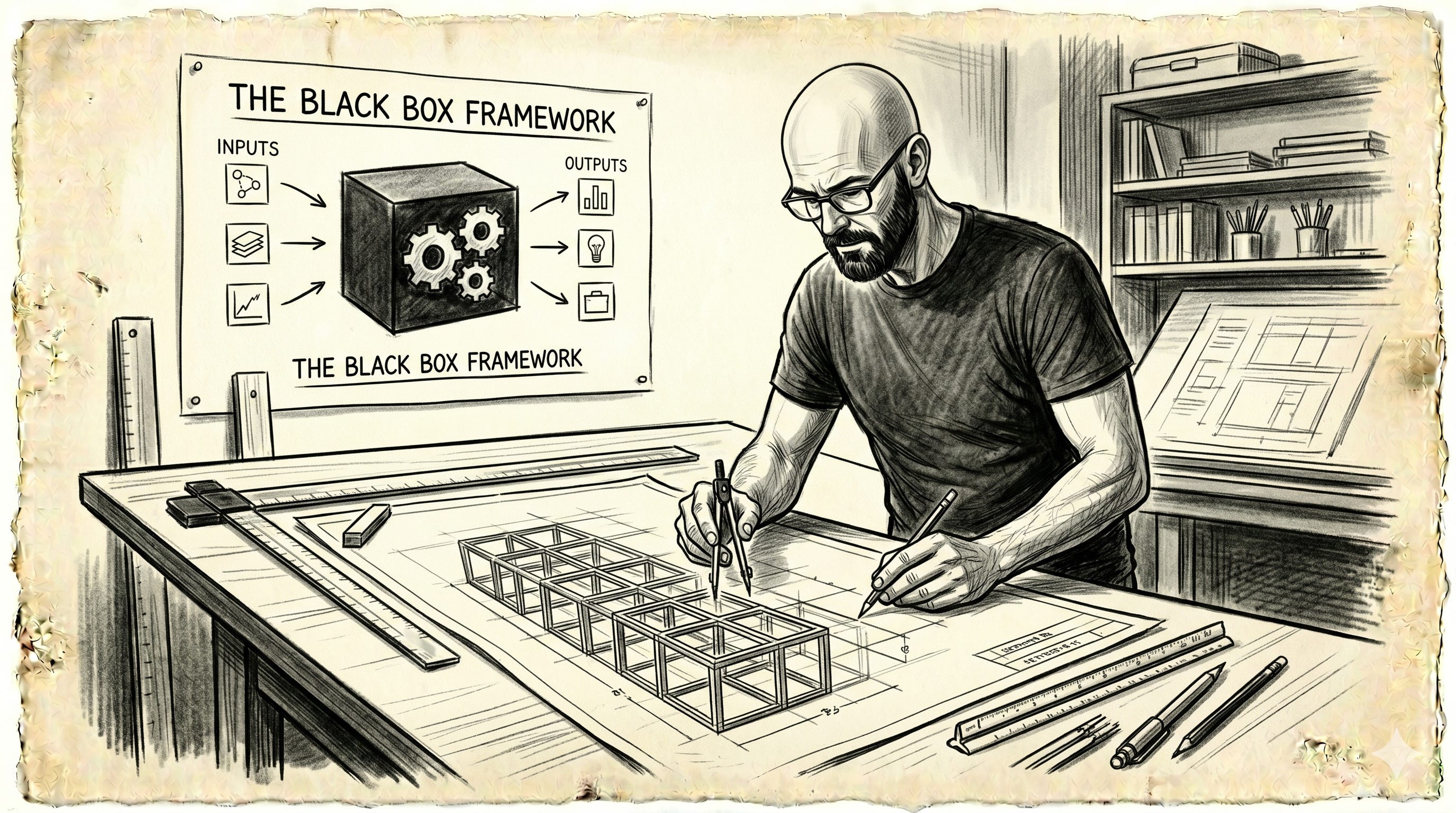
From Evidence to Architecture
In Article 5, we found the “Key.” You went into the basement, stayed quiet, and collected Private Proof. You found the small, boring logistics fix that a client actually paid for. You identified the sentence they repeated back to you. You survived the silence of the “Observation Mode” without needing the feed to clap for you.
But now, you face a new, more subtle temptation.
The moment a survivor sees a spark of traction, their old “Founder” instincts scream at them to scale. They want to hire a virtual assistant, buy a fancy domain name, and start drafting a 50-page business plan for a “Global Solutions Provider.” They want to take that one tiny, successful experiment and inflate it back into a “Big Vision” before the ink on the first invoice is even dry.
This is a trap. It is how you end up back in the “Generalist Expert” cycle, selling your life away one hour at a time while calling it a “startup.”
To build the Skyscraper of 2026, you don’t need a vision yet. You need a Framework. A framework is the bridge between a Job (selling your time to solve a problem) and an Asset (selling a repeatable system that solves a problem). It is the process of taking the “Marrow” you identified in your lab and turning it into a structure that can eventually stand without you. Before you can be a CEO again, you must become a Minimum Viable Authority.
Take a walk with me…
The Trap of the “Generalist Expert”
The most dangerous thing you can be right now is “helpful.”
When you are coming out of a pivot, you are hungry. You want to prove you still have value, so you say “yes” to everything that looks like a paycheck. You become a high-level Swiss Army knife. You do a little bit of strategy, a little bit of operations, a little bit of coaching, and a little bit of tech.
You tell yourself this is “diversifying,” but it is actually diluting. Being a Generalist Expert is the fastest way to stay stuck in the Identity Vacuum. Because you do everything, you are known for nothing. You have no margin because every project requires you to reinvent the wheel. You are still performing, just for a smaller audience.
The “Specialist’s Fear” is that if you narrow your focus to that one boring bottleneck you found in the basement, you will lose money. The reality is the opposite: Narrowing your focus is the only way to increase your margin. It allows you to stop selling your “resilience” and start selling a Result. To move forward, you have to stop being the person who can do anything, and start being the person who does one thing better than anyone else.
Building the “Black Box”
Once you have Private Proof that a specific solution works, your next job is to “productise” your brain. You need to move from selling “custom work” to selling a Black Box.
A Black Box is a repeatable framework where the client knows exactly what goes in (their problem) and exactly what comes out (the result), without needing to understand every micro-decision you make in the middle. If you are still explaining how you do what you do for forty minutes in every pitch, you don’t have a business; you have a very complicated hobby.
To build your Black Box, look at the project that gave you your first “Private Proof” invoice. Strip away the personality and the late-night emails. What was the logic?
Diagnosis: How did you identify the specific bottleneck?
Extraction: How did you pull the data or the problem out of the noise?
Architecture: How did you structure the fix?
Integration: How did you ensure the fix stayed fixed?
When you name these steps, you stop being a “Consultant” and start being an Authority. You aren’t “helping with logistics” anymore; you are implementing the Last-Mile Friction Framework.
This shift allows you to stop selling your hours and start selling the Asset. The client isn’t paying for your time; they are paying for the speed and certainty of the Black Box.
Pricing the Result, Not the Resilience
Founders who have survived a “Funeral” often make a common pricing mistake: they try to charge for their Suffering.
Because you spent years struggling, you feel like the value of your work is tied to how hard you work. You want the client to see your grit. But in the 2026 market, resilience is a commodity. Nobody is going to pay you extra because you survived a pandemic or a failed Series A.
The market doesn’t care about your “healing arc”; it cares about its own bottom line.
When you have a Framework, you stop pricing based on “Input” (how many hours it takes you) and start pricing based on “Impact” (the cost of the friction you are removing). If your 4-step framework saves a company $100,000 in lost shipping fees, that framework is worth $20,000, even if it only takes you four hours to implement.
By pricing the Result, you finally decouple your income from your presence. This is the first step toward building the skyscraper. You are no longer trading your life for a paycheck; you are deploying a structure that generates value.
The First “Asset”
How do you know when you’ve moved from a “Job” to an “Asset”?
It’s the Replacement Test. Ask yourself: “If I handed my notes and my framework to a competent stranger, could they deliver 80% of the result to the client without calling me?”
If the answer is no, you are still the engine. You are still the “Human Glue” holding the business together. An asset is a structure that exists independently of your mood, your energy levels, or your personal story.
Your first asset isn’t a team of ten; it’s a documented process. It’s the set of rules, templates, and decision-trees that govern your Black Box. When you have this, you have “Minimum Viable Authority.” You have a productised version of your expertise that can be sold, scaled, or eventually automated. You’ve successfully moved the value from your head to the page.
The Action Plan (Building Your Architecture)
To move from a “Founder in Exile” to an “Architect of Authority,” follow these three steps:
Name the Process:
Give your solution a proprietary name. Stop calling it “consulting.” Call it the [Your Niche] [Specific Result] System. This creates an immediate mental separation between you (the person) and the product (the system).Define the 3-5 Pillars:
Every effective framework has a handful of non-negotiable steps. What are yours? Write them down as if you were teaching a junior version of yourself.The “Fixed Price” Test:
Offer your next client a fixed price for the Outcome rather than an hourly rate for the Work. If you flinch, your framework isn’t defined enough yet. If you feel a sense of relief, you’ve just built your first asset.
Closing Statement (The Skeleton of the Skyscraper)
A “Big Vision” is just a dream until it has a skeleton.
The Minimum Viable Authority is the skeleton of your next skyscraper. It’s not flashy, it’s not public, and it doesn’t get you featured in tech blogs. But while other founders are out there pitching ghosts and performing reinvention, you are building a machine that actually works.
You are no longer guessing. You are no longer apologising. You have a framework, you have evidence, and for the first time since the “Funeral,” you have a business that is built on something stronger than your own exhaustion.
The architecture is set. Now, let’s start the construction.