
The Operator’s Manual: Why Your Framework Needs Rules, Not Vibes
Stop mistaking a named framework for a real business asset. Learn how to turn your expertise into rules, decisions, and repeatable delivery that does not collapse the moment you get tired.

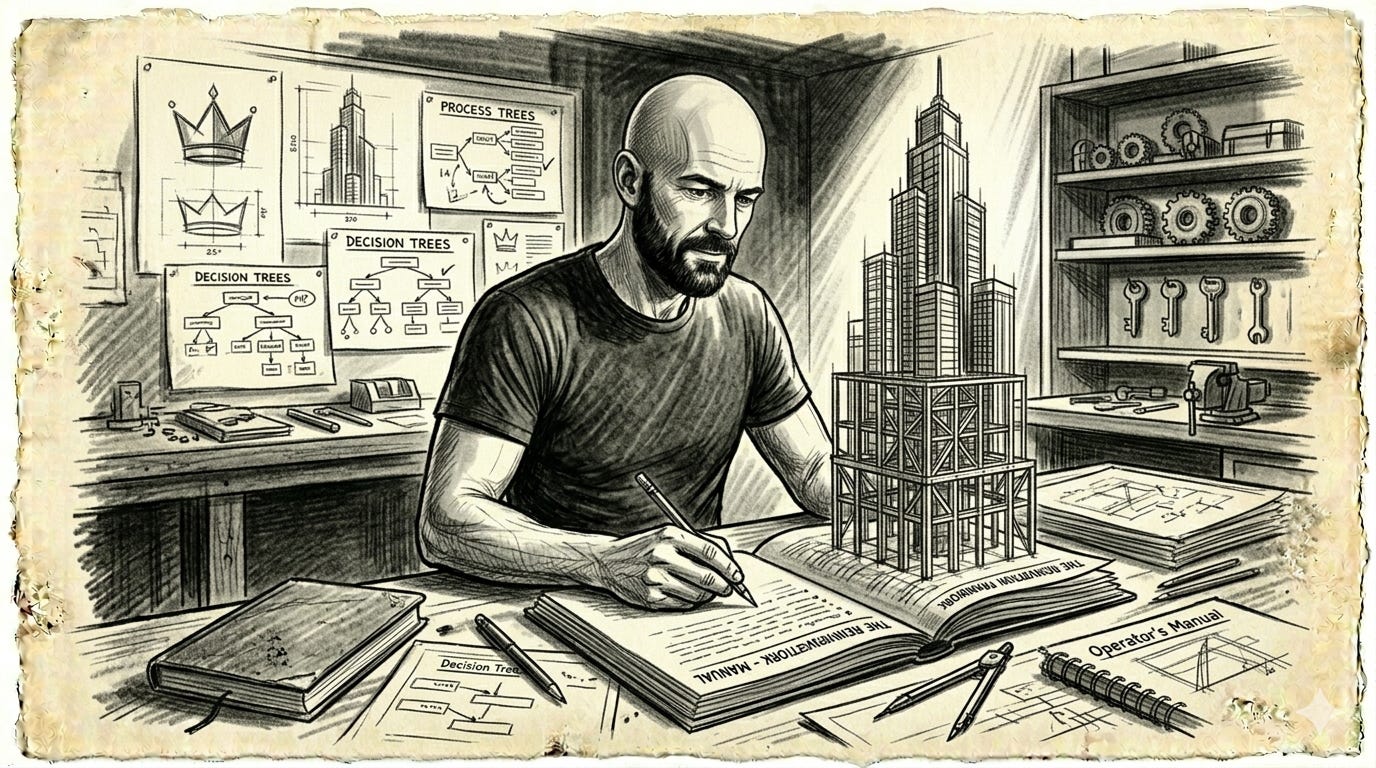
From Architecture to Instructions
In the last piece, we talked about the Minimum Viable Authority.
We took the small, boring proof from the basement and started turning it into architecture. We stopped selling time as if exhaustion was a pricing model. We stopped pretending that a founder who can do everything is somehow more valuable than a business that can do one thing properly.
We gave the work a skeleton.
A framework. A Black Box. A named process that could begin separating the value from the person carrying it.
And for about twelve glorious minutes, that feels like progress.
You write the name at the top of a page. You map the four pillars. You sketch the flow. You start saying things like “our methodology” without immediately wanting to crawl into the nearest storm drain. The work finally looks like something. It has shape. It has edges. It has the faint smell of a business asset rather than another awkward invoice held together by caffeine and panic.
But then comes the next problem.
Someone asks you how it works.
Not in the inspiring, podcast-interview way. In the practical way. The annoying way. The way a client, contractor, junior team member, AI workflow, or future buyer would ask.
What happens first? What happens if the client does not have the data? What do we refuse? What does good look like? When do we stop? Which part requires your judgement? Which part is just a checklist? What breaks if you are not in the room?
And suddenly your beautiful framework turns back into mist.
That is the next ghost to deal with.
A framework is not an asset because you named it. A framework becomes an asset when it has rules.
The Vibe Trap
Founders love frameworks because frameworks feel like adulthood.
They make the chaos look intentional. They turn instinct into a diagram. They give you something to put on a website that is not just “I am unusually good at solving this but please do not ask me to explain the exact mechanics because then we will both have to stare into the abyss.”
But there is a trap here.
A lot of frameworks are just vibes wearing a waistcoat.
They have names, pillars, arrows, and perhaps a tasteful little acronym that took far longer to invent than anyone will admit. But underneath the polish, the business still depends on the founder remembering everything, noticing everything, interpreting everything, and manually rescuing the project whenever reality refuses to follow the slide deck.
That is not a system. That is dependency with some sparkly stationery.
The Vibe Trap happens when the founder mistakes familiarity for structure. Because the work feels obvious to you, you assume it is clear. Because you have made the same decision a hundred times, you assume the decision rule exists. Because you can feel when something is wrong, you assume the quality standard has been defined.
It has not.
It is still living inside your nervous system.
And anything that only lives inside the founder’s nervous system is not yet an asset. It is a liability with charisma.
Founder Magic Is Not a Business Model
This is the uncomfortable bit, especially for people who have survived by being useful.
When you have been the person who spots the bottleneck, calms the client, translates the technical mess, rewrites the offer, fixes the spreadsheet, rescues the delivery, and somehow makes the whole thing work by Friday, it is tempting to call that genius.
Sometimes it is.
But if the business cannot access that genius without you personally bleeding into the carpet, it is not a business model. It is founder magic.
Founder magic is seductive because clients like it. They feel safe when you are in the room. They trust your pattern recognition. They enjoy the speed with which you can see through the nonsense and point at the real problem hiding underneath the polite one.
But founder magic has a hard ceiling.
It cannot be handed over. It cannot be priced cleanly. It cannot be automated properly. It cannot be taught without turning every training session into a rambling archaeological dig through your professional trauma.
And it definitely cannot scale while you are still the only person who knows why Step Two sometimes needs to happen before Step One.
The grown-up move is not to pretend your judgement does not matter.
The grown-up move is to turn your judgement into rules.
The Operator’s Manual
Every serious framework eventually needs an operator’s manual.
Not a brand book. Not a sales deck. Not a motivational Notion page with a moody quote about discipline at the top.
An actual manual.
The operator’s manual is where your framework stops being a clever explanation and becomes a repeatable delivery system. It is the place where you write down the rules that govern the work when you are tired, busy, irritated, distracted, or not there at all.
It answers the questions your ego would rather keep vague:
What problem is this framework actually allowed to solve?
What problems do we refuse, even if the client has money?
What information must exist before we begin?
What is the diagnostic sequence?
What are the common false signals?
What does a successful outcome look like in observable terms?
Where does the client usually misunderstand the value?
What decisions can a junior person make without asking?
What decisions must escalate?
What does “good enough to ship” mean?
The Operator’s Manual
This is not bureaucracy. This is architecture becoming usable.
A skyscraper is not built from the architect’s taste alone. It is built from drawings, tolerances, materials, sequences, safety rules, and people who know exactly what to do when the weather turns foul on a Tuesday afternoon.
Your framework deserves the same respect.
If it only works when you are inspired, it is not a framework. It is a performance.
The 80% Stranger Test
Here is the test I keep coming back to.
If you handed your notes, templates, rules, examples, and decision trees to a competent stranger, could they deliver 80% of the result without phoning you every fifteen minutes?
Not 100%. Calm down. We are not trying to remove all craft from the work and replace you with a beige operations goblin.
The last 20% may always be judgement, taste, experience, or that weird founder instinct that notices the client is saying “pricing problem” when they actually mean “trust problem.”
But the first 80% should not require a séance.
If someone else cannot understand the sequence, use the templates, apply the rules, and avoid the obvious traps, then the value has not moved from your head to the business. It is still trapped inside you, wearing a slightly better outfit than last month.
The 80% Stranger Test is brutal because it exposes the parts of your expertise you have been romanticising.
You may discover that your “proprietary framework” is three good instincts, one strong template, and a large pile of undocumented exceptions.
Good.
That is the beginning of asset creation.
Automation Will Not Save Vague Thinking
This is where the current business conversation gets particularly silly.
Everyone wants to automate. Everyone wants agents, workflows, prompts, dashboards, and little digital assistants scurrying around the business like caffeinated interns with API keys.
Fine. Good. Useful, even.
But automation does not fix vague thinking. It industrialises it.
If your framework is unclear, AI will simply help you produce unclear work faster. If your decision rules are fuzzy, automation will help you make fuzzy decisions at scale. If your offer depends on you personally interpreting every edge case, no workflow tool is going to magically convert that into a sellable asset.
Before you automate the Black Box, you have to know what is inside the Black Box.
That means writing down the rules before you write the prompt. It means defining the judgement before you build the workflow. It means resisting the urge to solve an operating problem with software when the real issue is that nobody has admitted how the work actually gets done.
AI is powerful. But it is not a substitute for intellectual honesty.
If your business is still powered by vibes, automation will just give the vibes a login.
The Manual Audit
So how do you start turning the framework into an operator’s manual?
Begin with the last successful delivery. Not the prettiest one. The real one. The one where the client got the result, even if the path there involved three awkward calls, one late-night rethink, and a spreadsheet that looked like it had been attacked by raccoons.
Then run the Manual Audit:
Map the sequence: What actually happened first, second, third, and fourth? Not what you wish happened. What happened.
Name the decision points: Where did you have to choose between options? What rule did you use?
Capture the refusals: What did you not do? What would have diluted the result?
Define the quality bar: What made the work good? Speed, clarity, margin, client confidence, reduced friction, fewer errors?
Write the common traps: Where do clients usually lie to themselves, misunderstand the problem, or chase the shiny thing?
Separate craft from admin: Which parts need your judgement, and which parts need a checklist?
Create the handover version: What would someone need to deliver 80% without you?
The Manual Audit
This will feel boring if you are addicted to founder adrenaline.
That is probably a sign you need it.
The next stage of authority is not more drama. It is not another reinvention post. It is not a grand announcement about the future of your new thing.
It is the quiet discipline of making your work legible enough to survive you having a bad week.
Closing Statement: The Rules Hold the Building Up
A vision makes people look up.
A framework gives the work shape.
But rules hold the building up.
This is where many founders flinch, because rules feel smaller than dreams. They feel administrative. They feel painfully unsexy. Nobody claps when you document an escalation point or define the minimum viable input before a client engagement can begin.
But that is exactly where the business becomes real.
The operator’s manual is the moment your expertise stops being a personal performance and starts becoming infrastructure. It is how your framework becomes teachable, priceable, improvable, and eventually scalable. It is how you move from being the genius in the room to building something that still works when you leave the room to make coffee, take a breath, or have an actual human life.
The Minimum Viable Authority gave you the skeleton.
The operator’s manual gives it bones strong enough to carry weight.
So before you announce the next version, automate the next workflow, or hire someone to “help with delivery”, do the boring thing.
Write the rules.
The skyscraper is not built from your vibes.
It is built from instructions that survive the weather.