
The Private Proof: Why Your Quiet Pivot Needs Evidence, Not Applause

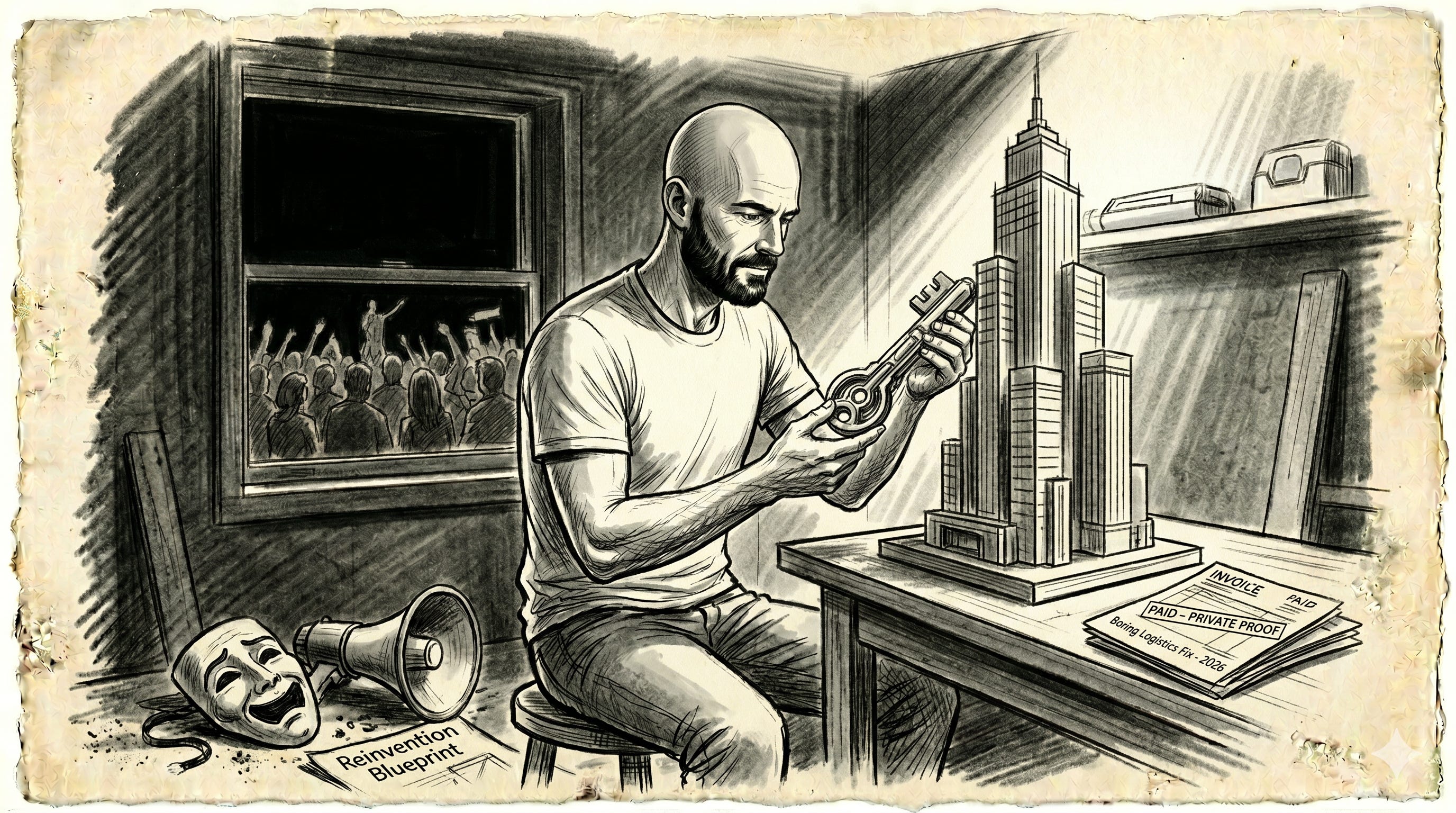
The Private Proof (Evidence Over Applause)
In Monday’s piece, we talked about the bravery of the quiet pivot. We discussed the relief that comes when you finally take off the “Visionary Costume” and stop performing your transformation for an audience that can’t actually help you build.
You’ve cleared the stage. The megaphones are put away. The “Build in Public” noise has been silenced.
But now you’re sitting in the workshop, alone with the blueprints, and a new, colder fear sets in. Silence is a vacuum, and if you aren’t careful, your ego will try to fill it with a new fantasy. The danger of a “Quiet Pivot” is that it can easily become a “Private Delusion.” Without the noise of the public to distract you, you still need a compass.
You don’t need a launch campaign. You need Private Proof.
The Freedom of the Secret
There is a specific, potent type of energy that exists only when nobody knows what you’re doing.
In the era of the “Founder Brand,” we’ve been conditioned to think that an idea isn’t real unless it’s being documented, hashtagged, and validated by the feed. But when I stopped trying to perform the GeoCrown pivot publicly, I tapped back into the energy I had when I was first starting out… the raw desire to create something simply because it was good enough to tell people about later.
When you share an idea too early, you aren’t just getting feedback; you’re inviting interference. Every “hole” in the concept becomes a target for public scrutiny. People (often well-meaning friends who would never actually buy from you) point out the obvious flaws. They shepherd you away from your goals before you’ve even built the ladder to get over the hurdles. They mistake the “bubbling” of a new idea for a leak that needs fixing.
By keeping your reinvention a secret, you give the idea room to be wild. You allow it to twist, settle, and evolve without having to explain the “broader picture” to someone who doesn’t get it. You get to branch off and test pieces of the work through isolated services… testing real needs from any direction without the pressure of a “Brand Identity.” Secrets are the laboratory of the specialist. In the silence, you aren’t defending a vision; you are observing a reality.
The “Interesting” Kiss of Death
The reason most founders perform their reinvention is that they are looking for absolution. They want the market to tell them that the painful pivot was wise, brave, and inevitably headed for success.
But applause is not a market signal. In fact, the most dangerous feedback you can get is from people who are socially invested in your “healing arc.” When you show a friend or a “supporter” your new direction, they will almost always tell you it’s “Interesting.”
In business, “Interesting” is a polite way of saying: “I understand the words you are saying, but I would never actually pay for this.”
Private proof is ruder, more clinical, and infinitely more useful. It happens when you stop asking for opinions and start looking for Friction. It’s the prospect who interrupts your clever framework to ask about a boring logistics fix. It’s the client who tells you your origin story is too long but your pricing for that one specific thing is actually quite good.
Private proof is found in the friction, not the flow. If everyone is agreeing with you, you definitely aren’t pivoting, you’re just preaching to a choir that isn’t going to buy. You don’t want a standing ovation; you want a small, boring invoice. One “ugly” paid test is worth more than a thousand supportive LinkedIn comments.
The Mirror of the “Difficult Client”
The final, and perhaps most uncomfortable, piece of private proof often comes from seeing your own ghost in someone else.
I recently worked with a client who behaved exactly how I did at the height of my “Visionary” era. He was too proud. He was always right. He had mountains of data that made his ideas look amazing, but he conveniently left out the data around the parts that were unknown to him. He was performing “Success” while his business was screaming for “Honesty.”
Watching him was like looking into a brutal, high-definition mirror of my own past mistakes. It was the ultimate private proof that the “Founder Costume”, the one where you have all the answers and none of the doubts, is actually a liability.
I realised that my value in this new chapter wasn’t in being the “King” of a vision, but in being the “Specialist” who could admit where the holes were and build a bridge over them. When you are testing a new direction privately, you have to be honest about the parts you don’t know yet. In “Build in Public” culture, admitting you don’t know something draws more attention to the holes than the core concept. But in the private room, that honesty brings solutions to the table at a much lesser cost.
Real reinvention is admitting that nobody knows what they’re doing for a very long time in this game. The difference is that the survivor is willing to sit in that unknown space until the pieces actually fall in line, rather than forcing them into a shape that looks good for the feed.
The Private Proof Audit
Before you even think about “launching” your next business or updating your headline to reflect your new identity, you need to collect your own ledger of evidence. This isn’t about what you think; it’s about what the world does.
The “Private Proof” Ledger:
The Repeated Sentence:
What is the specific phrase or problem a prospect describes without you prompting them? If they repeat your value back to you correctly, that’s a signal.The “Boring” Pivot:
What is the part of your offer you almost left out because it felt too “simple” or “unsexy,” but that the client keeps leaning toward?The Small Invoice:
Real money exchanged for a specific, unglamorous result. One tiny invoice from a stranger is worth more than a $24m pre-agreement from a ghost.The Honesty Gap:
A moment where you said “I don’t know yet” and the client trusted you more for it.The Silence Test:
Can you work on this for two weeks without telling anyone on LinkedIn? If the work itself isn’t enough to sustain you, you’re still chasing the applause, not the business.
The Closing Statement (The Basement Pivot)
The pivot becomes real when it survives contact with people who are not emotionally invested in your reinvention.
Your friends, your family, and your followers want you to be okay. They want to bless your next move so they don’t have to watch you suffer. The market, however, is indifferent. It doesn’t care about your “healing arc.” It only cares whether the new thing solves a real problem.
Until you have private proof, your pivot is not a business. It is a beautifully lit waiting room where you are hiding from the possibility of another failure.
Clear the stage. Stop the performance. Build the ladder over the holes while no one is watching. The Skyscraper of 2026 is being built right now, in the basement, behind closed doors. When you finally speak, you won’t be asking for permission to exist. You’ll be reporting from the other side of a foundation that has already been poured.
The funeral is over. The lab is quiet. Let’s get back to work.